General William Howe lowered his spyglass in astonishment. He could not believe what he was seeing! Dorchester Heights, a rocky ridge overlooking Boston Harbor, was crowned with rebel artillery! Some of his admirals and captains had warned him that the position needed to be occupied, but Howe had shrugged off the threat. Washington and the rebels posed only limited danger because Washington and the rebels had no artillery. Until now. Howe is reported to have said to some of his staff officers, “These fellows have done more work in one night than I could make my army do in three months.”
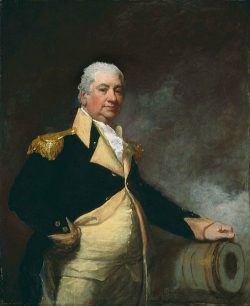
Washington’s chief of artillery was a twenty-five-year-old bookseller named Henry Knox. Knox was a direct descendant of one of the brothers of the Scottish Reformer, John Knox. Henry’s father, William Knox was an Ulster Scot who had immigrated from Derry to find a new life in Boston. He had become a shipbuilder, but had suffered financial loss and abandoned his family for the West Indies.
When word came that William Knox had died in the West Indies, Henry Knox had left school behind to become a clerk at a local bookstore in order to support his mother and siblings. Henry read all the books he could get his hands on, especially anything that had to do with history, military science, weaponry, engineering, and battlefield tactics. In a hunting accident, a shotgun went off accidentally that tore two fingers from his left hand. For the rest of his life, he wore a handkerchief tied around his left hand to conceal the missing fingers.
Henry was a decided patriot, and was witness to the “Boston Massacre.” He joined a local artillery militia company and gained hands-on experience in handling big guns. By the time he was twenty, Henry was able to open his own bookshop. He married one of the pretty girls who came into his shop to read. Lucy Flucker was the daughter of a prominent Bostonian Loyalist – her brother served in the British army. Lucy abandoned all to follow the destinies of her husband. When shots were fired at Lexington and Concord, Henry Knox knew that he must leave Boston behind or be arrested. He and Lucy slipped quietly out of town. Lucy had sewn Henry’s sword into her shawl to conceal it!
George Washington liked the stout young bookseller and was impressed by his expansive knowledge of tactics and engineering. Martha Washington took the pregnant Lucy under her wing. Henry Knox was a big man. During most of the war, he weighed over 250 pounds, sometimes approaching 300 pounds – even while on starvation rations. His booming voice and his massive bulk seemed to make him impervious to cold and bad weather of all sorts.
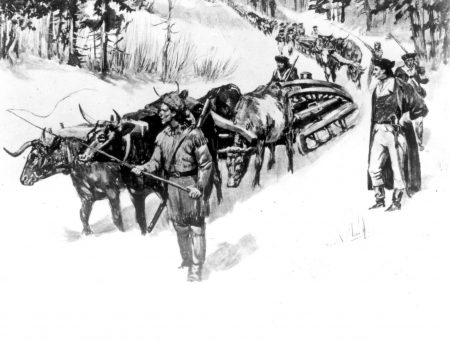
It was in the dead of winter of 75-76 that General Washington entrusted the young bookseller – who still did not have a commission, with the important mission of bringing heavy artillery from the captured Fort Ticonderoga to help relieve the siege of Boston. The story of the “noble train of artillery” has been told many times. Exactly 250 years ago, in January and February of 1776, Henry Knox performed the audacious feat of transporting 60 tons of cannon over 300 miles of lakes, rivers, mountains, and rugged trails to bring them to Boston.
The Lord providentially guided the expedition. He sent snow when Knox prayed for snow over which to pull the heavy sleds. For portions of the journey, the lakes needed to be open water. But to cross the Hudson River, Knox needed solid ice. He was undaunted even when one of the heavy guns broke through and went under. When lesser men would have left the gun behind, Henry Knox fetched it out of the frozen river.
Knox used horses as well as oxen to pull the heavy sleds that transported the cannon. Steep inclines up the Berkshire Mountains were long and grueling to men and beasts. But it was just as harrowing to get a 2,000 pound cannon safely down a snowy mountain when perched on a sled with runners. Knox was assisted by an experienced teamster named John Becker and his teenage son. By early February, the heavy cannon were moving into the camps of the American army at Cambridge. Under the devastating power of the American cannon, the British army under the command of General Howe decided that it was best to evacuate Boston.
The story of Knox’s subsequent contributions is just as fascinating as the story of his famous march with his “noble train of artillery.” Henry Knox earned Washington’s implicit trust and he kept it for the rest of the war. In the midst of discontent and rivalry among some of the officers of the Continental Army, Henry Knox was always loyal to Washington. Knox was at Washington’s side during the awful days at New York, when the Americans were harried and driven in shame and fear from post to post. Knox helped with the evacuation of Long Island when the American army was ferried through the fog to safety.
Knox supervised the famous crossing of the Delaware River when the daring Americans broke up the Hessian Christmas Party in Trenton. Above the howl of the blizzard, the booming voice of Henry Knox instilled confidence into the hearts of the troops. It was the field artillery of Knox, planted to sweep King Street in Trenton, that compelled the Hessian commander to surrender. Knox was with Washington during the bitter days at Valley Forge. He was at his side at Brandywine and at Germantown. Knox caused some significant delay at Germantown by insisting on a bombardment of the Chew House. When others blamed Knox for holding up the advance, Washington’s trust in his artillery chief never wavered.
At the Battle of Monmouth, in 1778, General Washington commended Knox for the splendid way that he handled the artillery. Knox saw the need for well-trained officers, and while Baron von Steuben drilled the troops of the line, Henry Knox started a training school at Pluckemin, New Jersey for instruction in tactics, artillery, and engineering. The school became the foundation of West Point Military Academy. While many know Knox for his winter march, few recognize him as the Father of West Point. At the Siege of Yorktown, Knox stepped aside to allow Washington to light the touch hole of the opening guns at Yorktown.
When George Washington resigned his commission just after Christmas in 1783, Henry Knox became the senior officer of the victorious American Army. Knox helped to organize the Society of the Cincinnati for his brother officers and their widows. Knox served Washington again as Secretary of War. In this important post, he supervised the building of the United States Navy and also laid plans for the military school at West Point. He negotiated treaties with Indian tribes and supervised campaigns to secure the Northwest Territory.
Worn out by war and service to his country, Henry and Lucy Knox retired eventually to Maine and his spacious mansion called Montpelier. He raised cattle, built ships, made bricks, and traded real estate. Out of thirteen children, only three of the Knox children survived to adulthood. Diphtheria, smallpox, and other childhood diseases took their toll. Washington often wrote kind letters of encouragement to his friend at these times of sorrow.
Henry Knox died in 1806 after accidentally swallowing a chicken bone. After 250 years, Knox is remembered by towns, villages, and counties all across the country that bear his name. Fort Knox in Kentucky and Knoxville, Tennessee, are two of the most prominent places that honor his memory.
General Henry Knox serves as an example of a man who overcame enormous difficulties and kept on going. A self-educated orphan who never had formal military training became by sheer determination one of Washington’s most trusted generals. He broke a trail through the snow and calls us all to follow his “noble train.” May God help us all to persevere, persevere, and persevere.
Bibliography
Henry Knox’s Noble Train by William Hazelgrove
Henry Knox: Visionary General of the American Revolution by Mark Puls