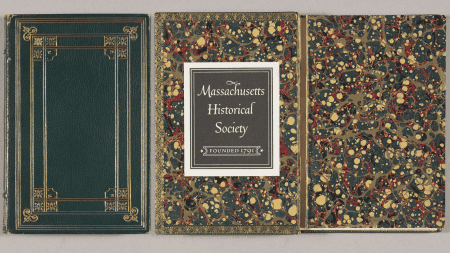
I recently came across a blog post from the Massachusetts Historical Society about some preservation work that they had done on some original Bradford manuscripts that they have in their collection. I figured it would be worth highlighting here, for any Bradford fans who might be reading.
The 1648 manuscript is the first of three known “dialogues” written by Bradford – simulated conversations between young men of Plymouth and old Separatist settlers, designed to educate the first group in real life. The Society says,
Sometime in the late 1800’s, this thin pamphlet was bound into a smart new Victorian leather binding with elaborate gold tooling. The fragile pages were sewn into a text of blank pages, but it made it difficult to see all the text, and turning the pages put a great deal of stress on the paper.
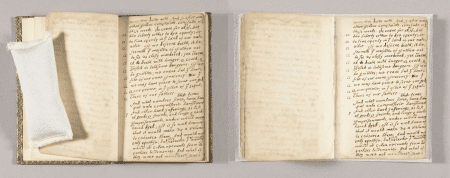
They continued:
The binding was beautifully made at the MHS in the nineteenth century, but it was difficult to see all the text, since the pages didn’t open fully. In 2023, one leaf of the pamphlet needed to go out on exhibit. We decided to remove the entire manuscript from the binding and after exhibition, mend and sew it into a paper cover, which is most likely what Bradford would have done originally.
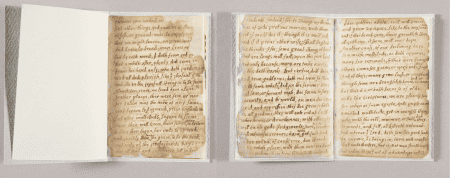
They also show work done on a fragment of the manuscript of a poem by Bradford, Some Observations of God’s Merciful Dealing with us in this Wilderness:
Another of our Bradford manuscripts, ‘Some observations of God’s merciful dealing with us in this wilderness, and His gracious protection over us these many years’ [fragment], had also been bound in the 19th century. The pages were attached along the spine to blank leaves making some of the text impossible to see. The manuscript was stained and too fragile to be used.
Because of the staining and acidity of the paper, Samantha decided to wash the manuscript. Washing refers to many types of water and solvent solutions used in paper conservation. Washing removes soluble acids, dirt, and can lighten stains. Removing acids makes the paper more flexible and less likely to break or tear. An added treatment done during the washing process neutralizes the iron in iron gall ink to prevent further corrosion. After washing, the pages were reinforced and lost areas filled with Japanese paper. After treatment the pages were digitized and then they were resewn into a paper cover.
Thanks to the Society for their preservation work, and for giving the public an insight into the process. You can read their original blog posts here and here.