What has not sung these words, and felt them echo in his heart?
More love to Thee, O Christ,
More love to Thee!
Hear Thou the prayer I make
On bended knee;
This is my earnest plea:
More love, O Christ, to Thee!
While perhaps this hymn is not universally known, surely the author of these lines is even less known. Today we look at the life of Elizabeth Payson Prentiss, the Godly woman who not only wrote this beloved hymn, but many other poems, books, and children’s books that have blessed and encouraged many along life’s way.
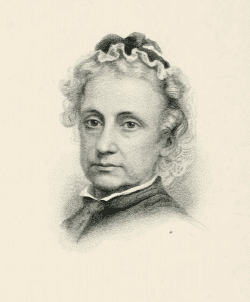
Elizabeth Payson was born in Portland, Maine, on October 26, 1818. She was the fifth born of eight children. She was born to a well-respected minister of the Gospel. Mr. Edward Payson was of Puritan descent. His ancestor, William Burdeck, had come from England to America in 1635 on the Hopewell. Burdeck married a fellow passenger named Mary Eliot, the sister of John Eliot, the missionary who was called the “Apostle to the Indians”. This Godly influence continued on through the following generations, and by the time Edward Payson was cradling his daughter Elizabeth in his arms, many of his ancestors before him had been ministers of the Gospel.
This godly heritage nurtured Elizabeth from her childhood on. She loved her father dearly. She was delighted when her father took time out of his day to tear up bits of paper for her and let her dump them out the window, pretending it was “snow”. She saw his joyful spirit with other people as he entertained guests in their home. She saw him prostrate upon his face before the Lord in prayer, and that sight was an influence upon her to her dying day.
Sadly, Edward Payson died of tuberculosis when Elizabeth was only nine years old. She was blessed with a sensible, Godly mother who devoted her life to raising her eight children for the Lord, and did so successfully.
As a girl, Elizabeth was cheerful and obedient. Her health was delicate and she was often ill, but she was a joy to the whole family. She loved the Lord and spent time reading the Bible and praying. Her interests were pure and good and remained steady her whole life – family, friends, good books, the outdoors, and playing with little babies! She had a compassionate heart and was quick to serve others. She was diligent in school and loved learning. Mrs. Payson allowed her to start a girl’s school in their home, and Elizabeth proved to be a gifted teacher as well.
When Elizabeth was twenty-one, she passed through a spiritual struggle which children who grow up in Christian homes sometimes go through. She had always loved God, but a deeper sense of her sins began to weigh on her heart, and she began to despair, wondering if she had ever been a Christian at all. By God’s grace, Elizabeth placed her hope in Christ fresh and new, and the Lord brought her out of her doubts and despair. It was a turning point in her spiritual life. She wrote, “The words ‘daily nearer God’ have an inexpressible charm for me. I long for such nearness to Him that all other objects shall fade into comparative insignificance,–so that to have a thought, a wish, a pleasure apart from Him shall be impossible.’ ”
Once earthly joy I craved,
Sought peace and rest;
Now thee alone I seek,
Give what is best;
This all my pray’r shall be,
More love, O Christ, to thee!
After this experience, Elizabeth was asked to teach at a girl’s school in Richmond, Virginia. It was her first time away from home, and quite different from her home in Maine! Though there were many challenges, she excelled in teaching, and the students loved her dearly. Two of her students were granddaughters of Patrick Henry!
When she was twenty-three, Elizabeth returned to New England and married George Lewis Prentiss, a pastor like her father, and the brother of one of her dearest friends, Anna Prentiss. Becoming a wife and mother was a new experience for her! She had always loved babies, but when her first child, Annie, was born, she realized for the first time what it was like to have the sole charge of such a precious gift. Being up through the night, caring for her baby whether she was well or sick – she used to think it was hard to be sick when she had her mother to wait on her as she lay in bed! No more lying in bed for Mrs. Prentiss!
Almost two years later their son Eddy was born. Elizabeth loved both of her children dearly, and the discipline of motherhood was good for her. Her own mother passed away about this time, which was a great sorrow to her, even though she rejoiced that her mother was home in Heaven.
Another bitter stroke came a few years later. Eddy’s health was never strong, and when he was four years old, he became so ill that his parents realized that they must give him up to God. Elizabeth cared for him day and night, rejoicing in each little service to her son. She told Eddy that he was God’s little lamb, and that Jesus would soon be bringing his little lamb home to Him. And Jesus did bring the little lamb Home.
A third child, Bessie, was born shortly after Eddy’s death. She was a healthy baby girl and a great comfort to the family. But a sudden infection set in, and Elizabeth had to give up this little lamb, too. In the midst of this heartbreak, she clung to Christ. Rather than becoming bitter, she humbly received the chastisement from the Lord, knowing that God does not make mistakes.
Let sorrow do its work,
Send grief and pain;
Sweet are thy messengers,
Sweet their refrain,
When they can sing with me,
More love, O Christ, to thee!
As the years went on, the Lord blessed the Prentiss family with three more healthy children. Elizabeth never forgot this deep sorrow, and because of it she was able to sympathize with and encourage many other suffering souls during the course of her husband’s ministry.
George and Elizabeth established a godly home for their children. Elizabeth was strict when it came to requiring obedience – “Mother’s” rules were the law! But she also nurtured her children with much love and joy, and it is evident in the letters we read of their family, that the Prentiss family had a very happy and harmonious home. Her letters are enjoyable to read – full of her love for her family and friends, her sense of humor, her sensitivity to those who are suffering, her enjoyment of God’s creation, and her spiritual reflections as she sought to love Christ more.
She delighted in her role as a pastor’s wife as well. She was grateful for all the opportunities it gave her to serve other people and help them in their troubles. George Prentiss was a well-beloved pastor, and many people came to the Prentiss home for help and counsel.
Elizabeth had published poems and stories in periodicals ever since she was a girl, but she had never seen herself as an author – in fact, she more often than not deemed her writings as “not good.” However, her readers came away encouraged by her writings. As her children grew up, she wrote several children’s books that had a wide influence, even across the ocean!
Probably the book with the widest influence was Stepping Heavenward. It is a fictional story written like a journal by a young woman named “Katy.” “Katy” chronicles her spiritual struggles, the joys and sorrows of married life and motherhood, and her seeking to know and love Christ more. Whether or not Elizabeth intended to mirror her own spiritual journey in the book, she certainly drew from her own well of experience, and the book went through many editions, was translated into several languages, and prompted many letters of appreciation from its readers.
The later years of Elizabeth’s life had both troubles and joys, and yet as she matured, she experienced more and more of the love for Christ that she sought all her life. Her Christianity was active and practical – she did not merely sit and think about God, but she let His love channel through her to be a servant to her family and friends and those under her husband’s pastoral care.
In 1878, when she was almost sixty years old, Elizabeth Prentiss had her final illness. She was working out in her garden as she loved to do, but the sun was hot and she came inside feeling sick. While she seemed at first to be on the mend, she never fully recovered, and several days later, passed into Glory. The last verse of her hymn, “More Love to Thee”, is a fitting close to her life:
Then shall my latest breath
Whisper thy praise;
This be the parting cry
My heart shall raise;
This still its pray’r shall be,
More love, O Christ, to thee!
Bibliography
More Love to Thee: The Life and Letters of Elizabeth Prentiss by her husband, George Lewis Prentiss